6. When the code changes
This is the step that shows what vouch is actually for.
First, commit what you have. Later in this step vouch diff compares the
values on disk with a git commit, so it needs one to compare with:
If the project is already in a git repository, just commit.
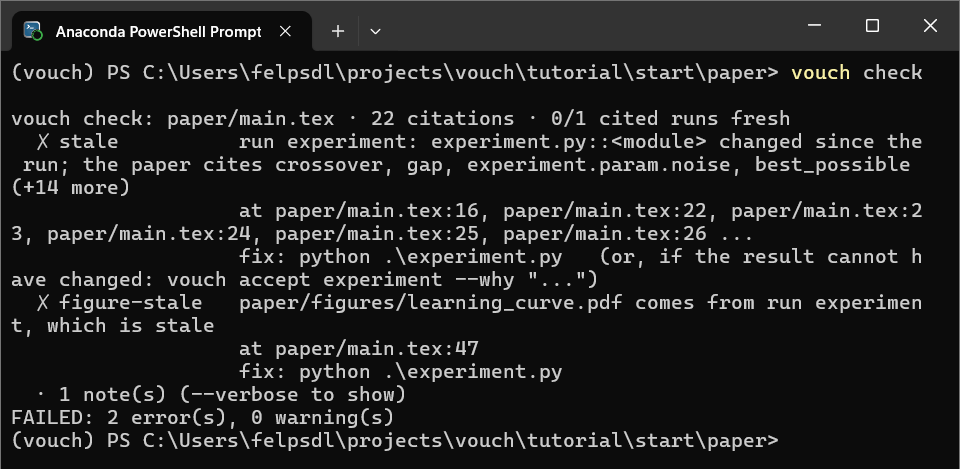
Now change K = 15 to K = 1 in experiment.py. vouch check notices before
anything is re-run:
$ vouch check
vouch check: paper/main.tex · 22 citations · 0/1 cited runs fresh
  ✗ stale          run experiment: experiment.py::<module> changed since the run; the paper cites crossover, gap, experiment.param.noise, best_possible (+14 more)
                   fix: python experiment.py   (or, if the result cannot have changed: vouch accept experiment --why "...")
  ✗ figure-stale   paper/figures/learning_curve.pdf comes from run experiment, which is stale
FAILED: 2 error(s), 0 warning(s)
Only real code changes count. Editing a comment or a docstring, or reformatting, leaves the run fresh. Re-run the experiment, then build:
$ python experiment.py
$ vouch build
  ✗ derive-error   crossover is cited here, but its definition failed (the derive-error at vouch_values.py:30)
  ✗ derive-error   crossover: ValueError: k-NN is not ahead with the most training points (at vouch_values.py:38)

20 CHANGED VALUES — re-read the sentences below

  NOW FALSE   knn_wins_large   HOLDS (0.873 > 0.8146) → FALSE (0.7842 > 0.8146)   (the claim no longer holds)
    paper/main.tex:35  "\vouchclaim{knn_wins_large}{With the most, $k$-NN is better}: it reaches ..."

  NOW FALSE   linear_wins_small   HOLDS (0.7806 > 0.5904) → FALSE (0.7806 > 0.7866)   (the claim no longer holds)
    paper/main.tex:32  "\vouchclaim{linear_wins_small}{With the fewest training points the linear model is better}: ..."

  SUSPICIOUS  gap   5.8 → -3.0   (Δ -8.88, -152.1%; sign flip; large move (152%))
    paper/main.tex:16  "The linear model is better with little data, but $k$-NN has the higher accuracy from ..."

  SUSPICIOUS  table learning_curve   12 cells changed, 8 suspicious
    ! 20.gap   -19.0 → +0.6   (sign flip; large move (103%))
    ! 20.knn   59.0 +/- 10.0% → 78.7 +/- 2.5%   (large move (33%))
    ...
    paper/main.tex:64  "\vouchtable{learning_curve}"
  ...
A nearest-neighbour classifier with k = 1 memorises every flipped label. The
paper's two claims are now false, and so is the abstract's premise: k-NN is no
longer ahead with the most training points, so crossover has no value. The
PDF would have printed the new numbers without complaint, but the sentences
around them would be wrong. vouch lists those sentences, and vouch check now
fails:
$ vouch check
  ✗ derive-error   crossover is cited here, but its definition failed ...
  ✗ false-claim    claim linear_wins_small no longer holds (...): 0.7806 > 0.7866
  ✗ false-claim    claim knn_wins_large no longer holds (...): 0.7842 > 0.8146
  ! suspicious     gap: 5.8 -> -3.0 (POSSIBLE PROBLEM: sign flip; large move (152%))
  ! suspicious     table learning_curve: 12 cell(s) changed, 8 POSSIBLE PROBLEM(s): ...
                   fix: re-read the table and what the text says about it, then: vouch ack learning_curve
  ...
FAILED: 4 error(s), 9 warning(s)
 The moment vouch exists for:
 K = 15 becomes K = 1, two claims flip false, and
vouch check fails before the wrong PDF ever ships.
What else did the re-run change?
vouch build and vouch check list the values the paper cites, because
those are the ones whose sentences need re-reading. But the run recorded 36
values, and most of them never reach the paper. vouch diff compares every
recorded value with your last commit:
$ vouch diff
vouch diff: HEAD → working tree · 41 changed · 0 added · 1 removed · 29 unchanged

  run experiment
      ● evaluate.knn.n_train_640.acc         87.3 +/- 1.4% → 78.4 +/- 1.3%   ↓ Δ -8.88 pts, -10.2% relative   worse   ! large move (10%)
      ● evaluate.knn.n_train_20.acc          59.0 +/- 10.0% → 78.7 +/- 2.5%   ↑ Δ +19.6 pts, +33.2% relative   better   ! large move (33%)
      ● experiment.param.k                   15 → 1   ↓ Δ -14, -93.3%   ! order-of-magnitude change; large move (93%)
        evaluate.knn.n_train_40.acc          77.6 +/- 2.7% → 73.9 +/- 2.7%   ↓ Δ -3.68 pts, -4.7% relative   worse
        ...
        evaluate.knn.n_train_20.train_acc    76.0 +/- 5.5% → 100.0 +/- 0.0%   ↑ Δ +24 pts, +31.6% relative   better   ! large move (32%)
        ...
  derived
      ● gap                                  5.8 → -3.0   ↓ Δ -8.88, -152.1%   worse   ! sign flip; large move (152%)
  claims
      ● knn_wins_large                       HOLDS → FALSE   worse   ! NOW FALSE; margin 0.0717 → -0.0373
      ● linear_wins_small                    HOLDS → FALSE   worse   ! NOW FALSE; margin 0.322 → -0.00763
  table learning_curve
      ● learning_curve.20.gap                -19.0 → +0.6   ↑ Δ +19.62, +103.2%   ! sign flip; large move (103%)
        ...
  removed
    - ● crossover                            80
  figures
    ~ ● paper/figures/learning_curve.pdf     the figure file changed (run experiment)

  ● cited in the paper; `vouch changes` lists the sentences to re-read
How to read a line:
- old → new, as the paper would print it.
- ↑ / ↓ and Δ: the direction and size of the move. For percentages, Δ is in percentage points; for a mean ± std, it is the change in the mean.
- better / worse appears because
vouch.tomlsaysbetter = "higher"for accuracies. A claim that stops holding is alwaysworse. - ● marks keys the paper cites. ! lists the same warning signs
vouch builduses: sign flip, large move, and so on.
vouch diff only reads. It doesn't acknowledge anything or touch the
baseline, so you can run it as often as you like.
The full list is long, partly because timings (*.time) differ on every run.
--key narrows it to keys that contain a substring or match a glob. Try the
training accuracies, which the paper doesn't cite:
$ vouch diff --key train_acc
vouch diff: HEAD → working tree · 6 changed · 0 added · 0 removed · 6 unchanged

  run experiment
        evaluate.knn.n_train_20.train_acc    76.0 +/- 5.5% → 100.0 +/- 0.0%   ↑ Δ +24 pts, +31.6% relative   better   ! large move (32%)
        evaluate.knn.n_train_40.train_acc    82.5 +/- 5.0% → 100.0 +/- 0.0%   ↑ Δ +17.5 pts, +21.2% relative   better   ! large move (21%)
        evaluate.knn.n_train_80.train_acc    86.0 +/- 2.6% → 100.0 +/- 0.0%   ↑ Δ +14 pts, +16.3% relative   better   ! large move (16%)
        evaluate.knn.n_train_160.train_acc   86.0 +/- 3.9% → 100.0 +/- 0.0%   ↑ Δ +14 pts, +16.3% relative   better   ! large move (16%)
        evaluate.knn.n_train_320.train_acc   89.3 +/- 2.6% → 100.0 +/- 0.0%   ↑ Δ +10.7 pts, +12.0% relative   better   ! large move (12%)
        evaluate.knn.n_train_640.train_acc   87.4 +/- 0.9% → 100.0 +/- 0.0%   ↑ Δ +12.6 pts, +14.4% relative   better   ! large move (14%)
This explains the drop in test accuracy. With k = 1, every training point is
its own nearest neighbour, so k-NN gets 100% on the data it trained on, noisy
labels included: it has memorised them. Notice that vouch calls this better.
The label only follows the direction you declared for the key; deciding what
a move means is still your job.
A few other forms you'll use:
$ vouch diff --cited                # only what the paper cites
$ vouch diff main                   # this branch against main
$ vouch diff HEAD~3 HEAD            # two commits
$ vouch diff main --md diff.md      # a Markdown report for a pull request
Keep the result, or undo the change
After a change like this you have two options:
- Keep the new result. Rewrite the sentences and the claims until they are
true again. Then acknowledge each change you have re-read, with
vouch ack KEY,vouch ack learning_curvefor a whole table, orvouch reviewto step through them. vouch records who acknowledged each change and when. - Undo the change. Set
K = 15again, re-run and rebuild. The values return to the ones you had acknowledged, and nothing is pending:
vouch diff confirms the undo. Every result is back to what you committed;
only the timings differ, so leave them out:
$ vouch diff --key '*acc'
vouch diff: HEAD → working tree · 0 changed · 0 added · 0 removed · 24 unchanged
Leave vouch watch running
So far you've run vouch build after every change. vouch watch does it for
you: leave it running in a second terminal and it rebuilds whenever a run
records new values or you save the paper, vouch_values.py or vouch.toml.
After each rebuild it prints what moved, in the same format as vouch diff.
Had it been running while you undid the change above, this is what it would
have printed when python experiment.py finished:
$ vouch watch --quiet
[18:28:19] vouch watch: building, then watching for new values (Ctrl-C to stop)
  wrote 3 file(s)

[18:29:02] .vouch/runs/experiment.json changed
  42 value(s) moved since the last build:
    run experiment
        ● evaluate.knn.n_train_20.acc          78.7 +/- 2.5% → 59.0 +/- 10.0%   ↓ Δ -19.6 pts, -24.9% relative   worse   ! large move (25%)
        ● evaluate.knn.n_train_640.acc         78.4 +/- 1.3% → 87.3 +/- 1.4%   ↑ Δ +8.88 pts, +11.3% relative   better   ! large move (11%)
        ...
  wrote 3 file(s)
It never runs the experiment for you; you still run python experiment.py.
Add --then "latexmk -pdf -cd paper/main.tex" to recompile the PDF after each
rebuild too.
Full reference: Comparing runs and live rebuilds, Change notification, Freshness.
Next: 7. Submitting.